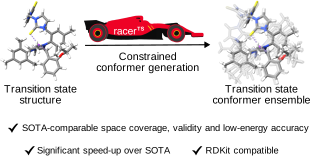
Our paper proposes racerTS, which generates transition state conformers via a constrained distance geometry approach, a modified approach from RDKit conformer generation.
We describe the algorithm and compare it with CREST and GOAT as benchmarks, showing that we (out)perform state-of-the-art in terms of accuracy, exhaustiveness and validity, at a order of magnitude acceleration.
The method can be used to accelerate high-throughput catalyst screening and generate transition-state datasets for machine learning applications, enabling broader ML adoption in catalysis research.